Company of Heroes 3
The Project
Nominated for best strategy game of the year, Company of Heroes 3 is an action focused, real-time strategy game released on PC and console. Set in the Mediterranean theatre of World War 2, players take command of The U.S. Forces, British Forces, Wehrmacht, or Deutsches Afrika Korps and fight their way through some of history’s greatest battle.
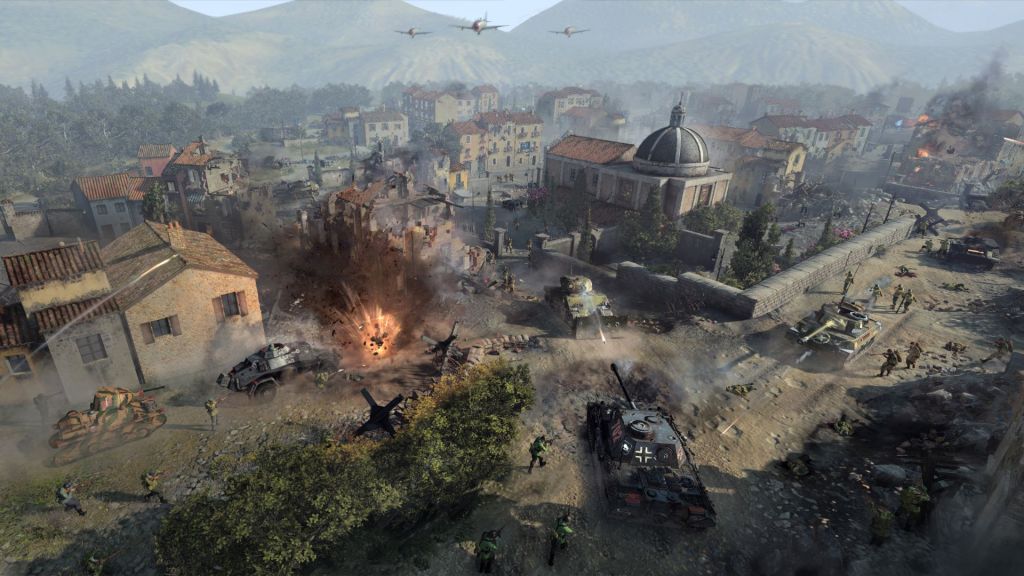
COH3’s action-focused, tactical gameplay combined with it’s deep, strategic choices blends the action and strategy genres into a unique and unforgettable experience. The use of combined arms, combat awareness, strategy, and tactical choices can turn the tide of battle from defeat to victory at any given moment. Every battle in COH3 tells a unique story through it’s deep and rich emergent gameplay and the variety of impactful choices a player can make each time they play.
My Role
I joined the Company of Heroes 3 team during the early stages of pre-production as a game designer focused on moment-to-moment gameplay, combat, and gameplay systems. Over the course of COH3’s five and a half year development, my responsibilities changed and adapted based on the needs of the project.
During pre-production, I was focused on creating conceptual design documents for gameplay systems, factions and combatants. I was also responsible for prototyping design concepts in engine to prove out ideas and build a foundation to work from before hitting production.
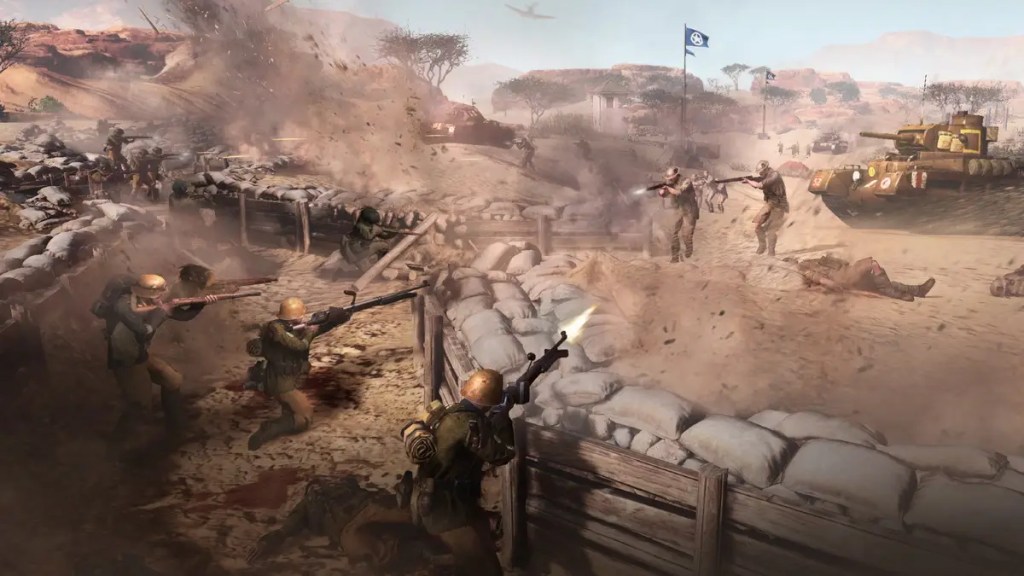
During production my focus changed to iteration and content creation. During this phase I designed and implemented four unique, asymmetric RTS factions, dozens of combatants with unique profiles, behaviours, weapons, and combat roles, and over 100 unique player and combatant abilities. I also developed and iterated on multiple gameplay and combat systems such as cover mechanics, projectiles, abilities, tank riding, breaching, construction, etc. In the final stages of development I focused on polishing content, bug fixing, and preparing the game for ship.
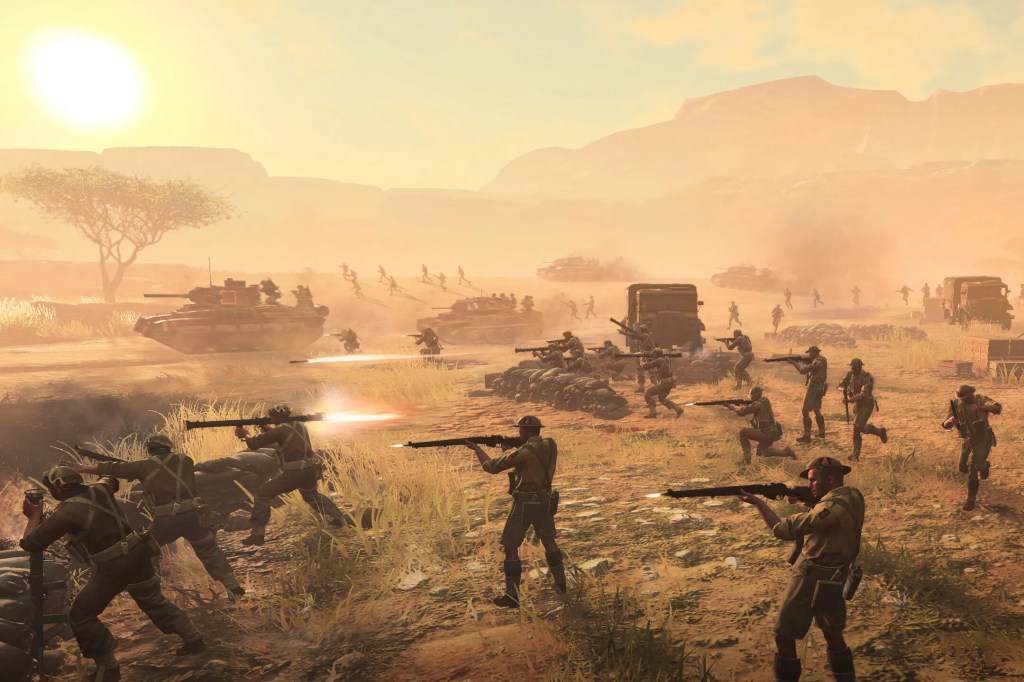
By the end of the project I was promoted to senior designer and became a primary point of contact for nearly all gameplay related content and systems. As also the primary content creator on the gameplay team, I was also responsible for being an expert in Relics’s proprietary engine and tools. I worked closely with central game engine and development teams to help improve workflows and tools for existing and future projects.
Gameplay
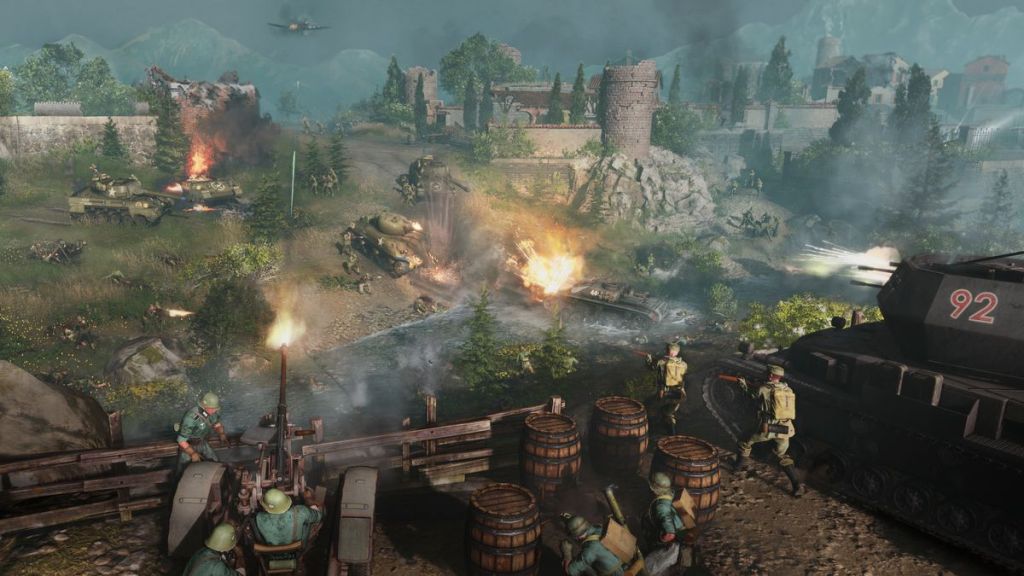
Company of Heroes 3 is a game that revolves around strategy and tactics, where the moment-to-moment gameplay is constantly evolving, forcing players to continuously react and adapt to what is happening to be successful. Company of Heroes 3 provides players with a variety of unique features and mechanics to create a dynamic combat system that support this style of emergent gameplay. Below are some examples of the core gameplay mechanics and abilities that went into the combat system that I helped design and implement for Company of Heroes 3.
Core Mechanics
Suppression
Players use combatants such as Heavy Machine Gun squads to suppress enemy infantry in a target area, forcing them prone, slowing, and eventually immobilizing them. This mechanic forces their opponent to use a variety of tactics such as spreading out their infantry, flanking, and using counters such as artillery, snipers, or vehicles to break through enemy defences.
Weapon Teams
Weapon teams are a unique type of combatant in Company of Heroes, such as heavy machinegun teams, mortar teams, anti-tank gun teams, etc. Unlike infantry squads, these combatants focus around their main weapon and have unique attributes such as a limited firing arc, setup and pack-up times to be able to fire and / or reposition, and have a minimum squad entity count to be able to use the main weapon they carry. If the entity count falls below this threshold the remaining infantry entities drop the weapon and retreat off-map, allowing any other squad to come along and capture and use the weapon, in turn converting the capturing squad into a new weapon team.
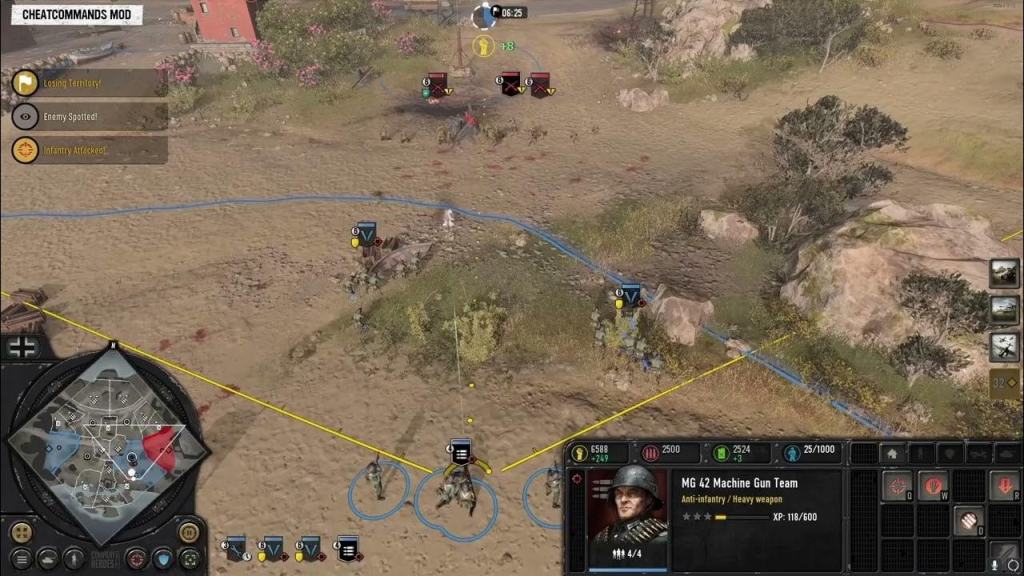
Weapon teams are very powerful tools for the player to use but their mechanics also create significant limitations, weaknesses, and vulnerabilities that the player must be aware of and bolster to be effective. This is another mechanic in Company of Heroes that heavily supports the design intention of encouraging players to use a variety of different combatants that support one another’s strengths and weaknesses through combined arms tactics.
Capture
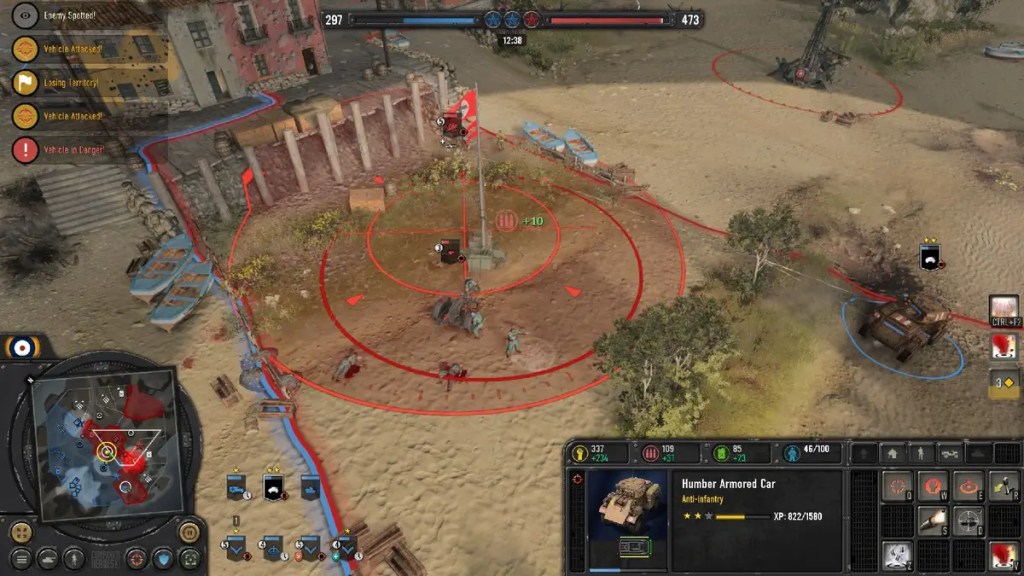
Players must capture territory points to earn resources. The game’s economy revolves around this feature. Players can also capture dropped weapons from defeated enemy squads, such as heavy machine guns, flamethrowers, or artillery weapons. This allows players to use weapons previously not available to them, increasing their range of tactics and creating new opportunities of gameplay.
Armour
In Company of Heroes 3, not all weapon types are effective against certain targets. For example, small arms fire from weapons such as rifles and machine guns have no effect against armored vehicles, tanks or defensive structures such as bunkers. Players must use a range of combined arms consisting of different combatant types, classes, and weapons to be effective against different targets.
Directional Cover
Company of Heroes 3 utilizes three types of cover: Garrison, Heavy, and Light, which all provide different degrees of defensive bonuses such as reduced received accuracy and damage. Players position their squads behind cover to gain advantage over their target and defend territory. The use of cover promotes tactical gameplay such as flanking, ability usage, and positioning.
Garrisoning
Players can use both buildings and vehicles to garrison their squads. Buildings provide 360 degree line of sight and heavy cover while vehicles allow infantry troops to be rapidly transported around the battlefield. Both types of garrisoning have strong tactical advantages and risks that the player must use to their advantage. For example, garrisoning a building provides a strong defensive bonus but forces the combatants to be static, allowing the opposing player to capture undefended territory. Vehicle garrisons provide a defensive bonus and mobility but if the vehicle is destroyed while garrisoned, the garrisoned troops inside will be killed.
Destruction
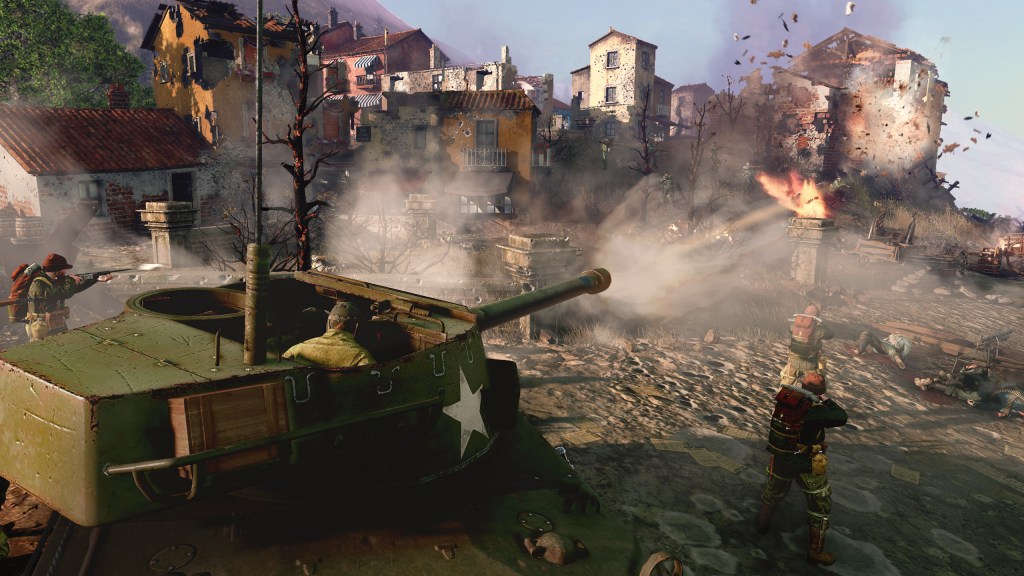
In Company of Heroes 3, nearly every single object on a map is destructible; the buildings, fences, rock wall, trees, etc., even the terrain itself is malleable to some degree. This makes every map an organic and dynamic battlefield. Line of sight blockers and static cover placements can be destroyed, craters are formed from heavy artillery to create new cover spots, constantly forcing players to adapt their tactics.
TrueSight
Line of sight is a critical component of Company of Heroes 3. Players can use line of sight blockers such as buildings, terrain, hedges, or smoke to protect themselves from enemy fire, hide their advance, or create opportunities to ambush their opponent.
Squad Preservation
Unlike most traditional RTS, in COH3 players must keep their squads alive to be successful. retreating, healing, and reinforcing squads to full strength helps squads earn powerful veterancy bonuses over time. By the late game, the veterancy bonuses squads have earned can be the difference maker between victory and defeat.
The act of retreating and ceding territory to keep squads alive also creates a natural sense of eb and flow to the battlefield. This is a critical part of the “dance of combat” in Company of Heroes 3 that helps set it apart from other similar strategy and action games.
Abilities
Unlike most traditional RTS, Company of Heroes 3 is a very action-focused strategy game with a heavy reliance on player and combatant ability usage. Each combatant in the game typically has anywhere from two to four abilities. Considering COH3 has four factions with over 20 combatants in each faction, it meant designing and implementing over 100 abilities for launch. This posed a challenge for creating abilities that were unique and served a definitive and useful purpose for gameplay.
To help solve this challenge, abilities in COH3 were categorized into four major archetypes: damage (AoE, DoT, etc.), modifier (buff / debuff), support (recon, LOS blocker, etc.), and construction. Each ability was designed to serve a distinct purpose and be a tool for the player to support a variety of different playstyles and tactics, and to help better define combatant roles. For example, an assault squad could use a flame grenade ability to push enemies out of cover and turn the tide in a fight, or a support squad could fire a smoke barrage ability to block line-of-sight and conceal an advance, or an infiltration squad could use a recon ability to track enemy movement in the fog of war. Below are some additional examples of the abilities I designed and developed throughout the project and the role they served for gameplay.
Damage Abilities
Damage abilities in COH3 came in all shapes and sizes, from DOT, AOE, projectile, hit-scan, targeted, and random location. The most common damage ability in the game was the grenade ability. This ability involved a combatant throwing a projectile at a target location and causing AOE damage in a defined radius. Grenade ability types varied, including small radial damage, heavy damage (satchels), dot damage (flame grenades), stun, smoke, and cluster (multiple grenades thrown at the same time). Each grenade ability came with its own pros, cons, and costs that the player would need to evaluate in the moment.
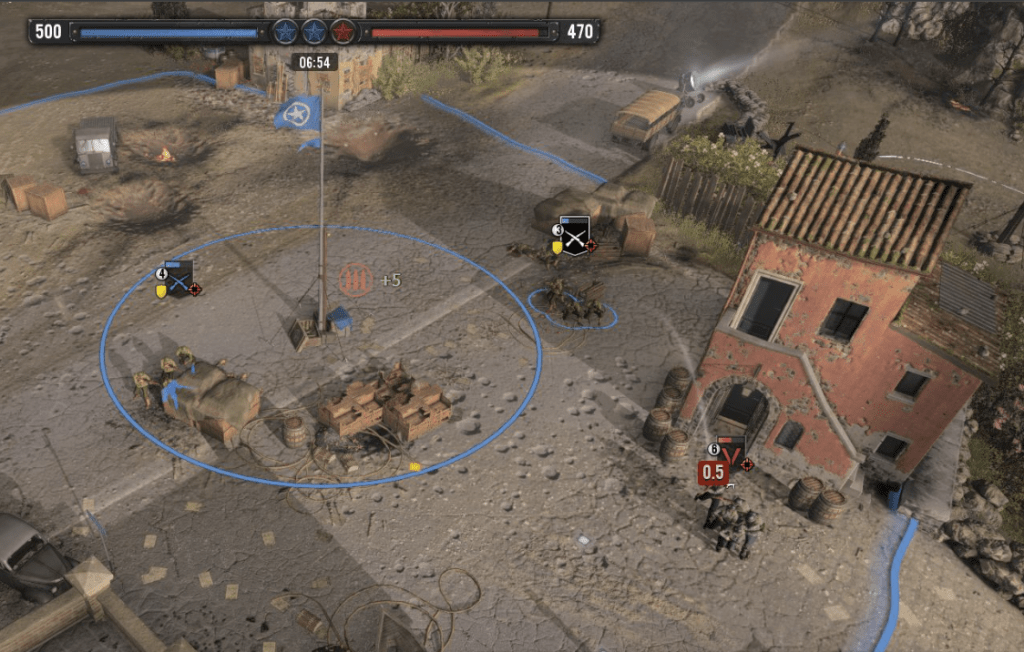
Another common damage ability was that of artillery strikes. These abilities were either player abilities with artillery projectiles flying in from off-map or were fired directly from a variety of combatants. Artillery abilities typically fired multiple projectiles from a source and barraged a target area, causing a wide array of AoE and / or DoT damage. They abilities were typically used to “soften” an enemy’s defensive line, destroy static structures, or reposition enemy troops before advancing.
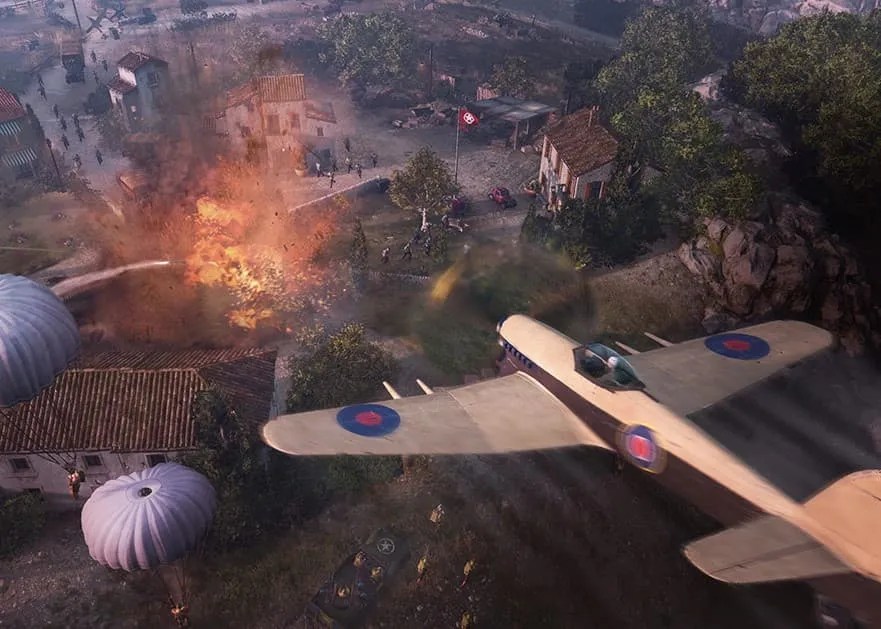
The last most common damage ability were player abilities in the form of airstrikes. These abilities were typically more scarce due to their high costs and cooldowns but could have significant impacts on gameplay if timed and used correctly. Examples included planes flying in from off-map, conducting sweeping attacks with heavy machine gun fire or bombs, or loitering a target area for a duration and searching for designated targets to attack.
Modifier Abilities
Modifier abilities in COH3 were used as “buffs” to the player or their ally’s combatants or a “debuff” used against enemy combatants. These abilities either came as a passive or timed ability and could be targeted, self-targeted, or activated via an aura from a nearby source such as a game object or combatant. Typical modifiers that were applied to combatants included bonuses to movement speed, rate-of-fire, accuracy, damage, capture-rate, received accuracy, reload time and line of sight, where negative bonuses (debuffs) would subtract from these attributes.
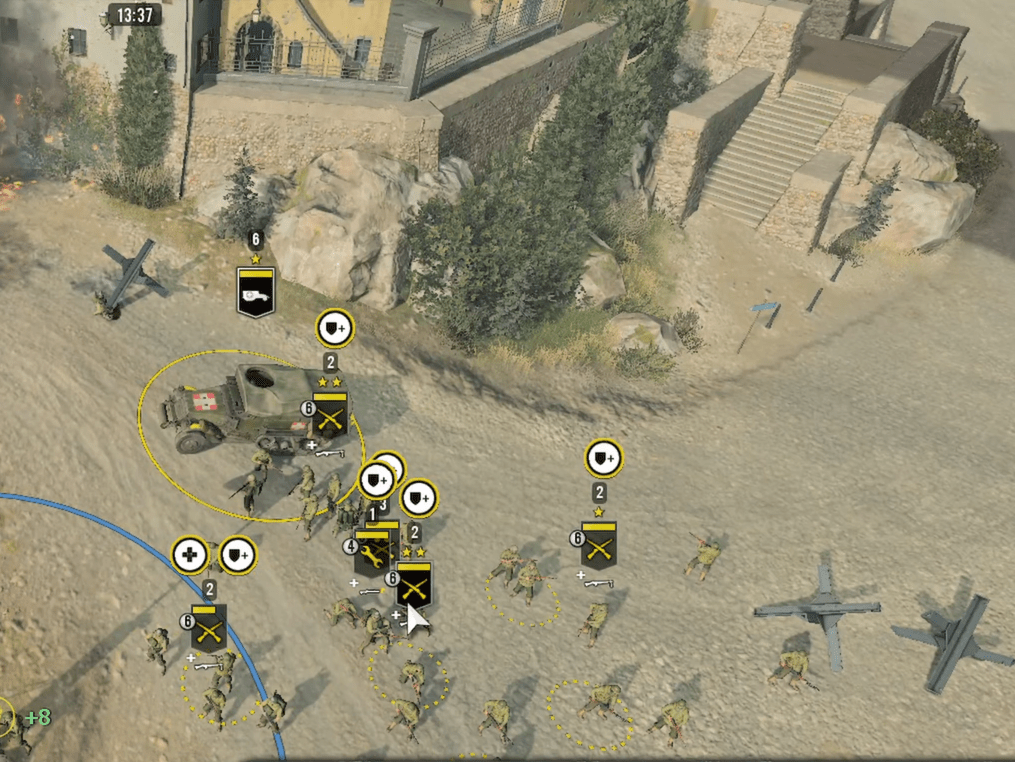
Similar to damage abilities, these modifier abilities were used to add variety to base combat engagements, allowing the player to create emergent gameplay and use a variety of tactics to achieve their goals. For example, a speed boost ability could be used on a close-range combatant to quickly close the gap between them and an enemy, allowing the player’s combatant to take less damage upon approach and deal more damage at their ideal combat range. Another example is a modifier ability that applies bonuses to accuracy and rate-of-fire, allowing a combatant that would typically lose an engagement against a certain enemy win the fight.
Support Abilities
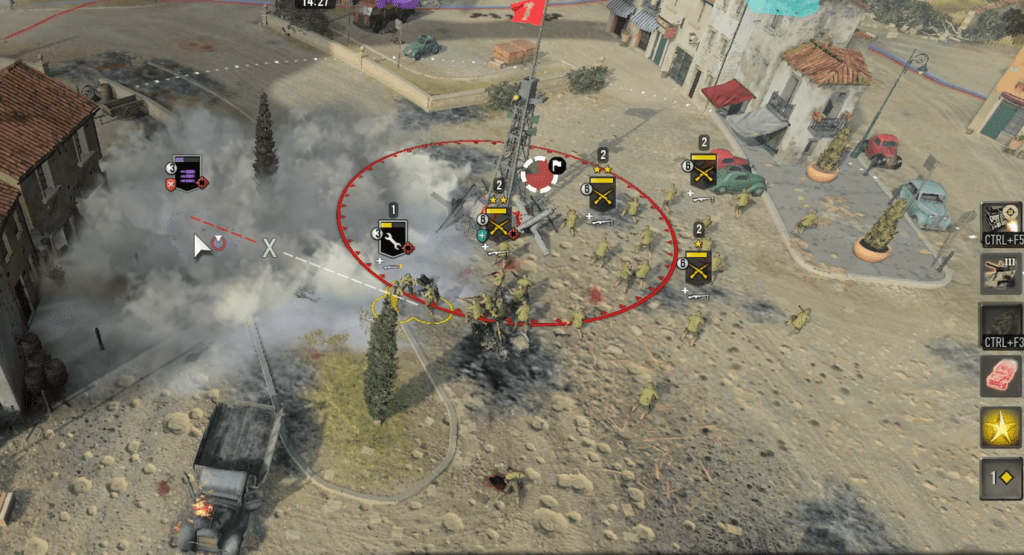
Support abilities in COH3 were defined as essentially non-combat abilities. These abilities were typically used to gain, conceal, or distort information in order to achieve a tactical advantage. Examples of these include but are not limited to the player calling in a reconnaissance plane to reveal the fog of war, combatants firing smoke screens to block line of sight, deception abilities to feign artillery or airstrikes, or detection abilities to reveal unit types in the fog of war and track their movement. Information is power and these types of abilities allowed players to make interesting decisions and informed choices to achieve a competitive advantage over their opponent.
Construction Abilities
Typically construction abilities were used to construct a wide variety of proximity mines that caused significant damage to infantry and vehicles. Mines could also potentially cause different status effects such as stunned or engine damage, significantly slowing a vehicle making it much more vulnerable to attack. Other examples of construction abilities included constructing heavy machine gun or mortar bunkers to defend an area, observation or recon posts to gain line of sight of an area or to detect nearby enemies in the FOW, or command posts that buffed nearby allies and came with its own ability suite such as artillery strikes and recon planes.
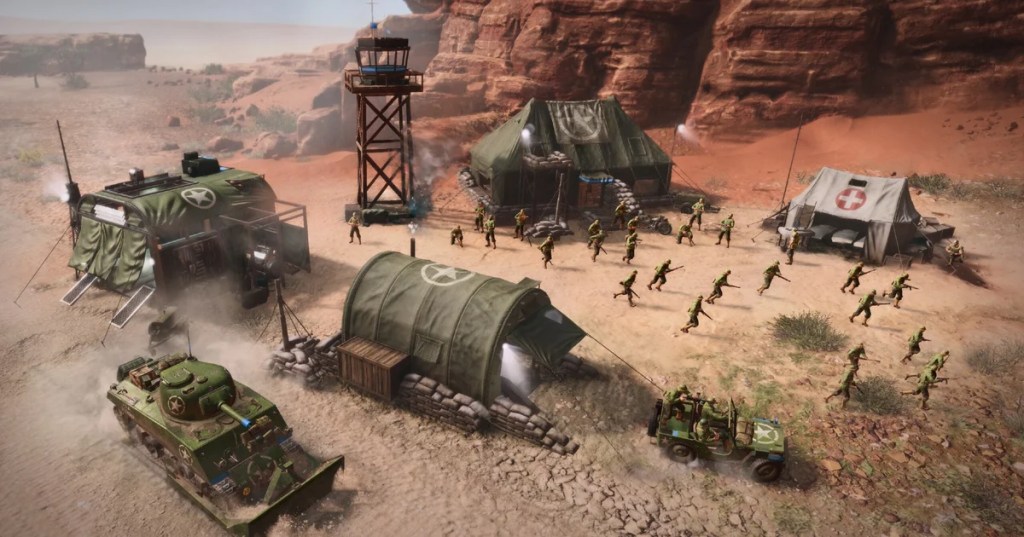
These types of abilities allowed players to change their playstyle and adapt their strategy. It allowed them to employ heavily defensive tactics and focus on making strong counter-attacks to achieve victory. They also help define faction designs and combatant roles. Lastly, they could turn the tide of battle in a big way. A massive, powerful tank that has a player outgunned hitting a heavy mine right before it destroys their forces is now immobilized and be easily picked off, allowing the player to make a big comeback. There is a reason why one of the COH’s community favourite sayings is “mines win games”.
Combat System
Company of Heroes 3’s combat system was designed to focus primarily around combatant positioning and variety, ability usage, armour system, a degree of randomness (accuracy, penetration chances, etc.), and a mix of hard and soft-counters. Although hard counters exist, these combatants are still vulnerable if not used correctly, even from the target they are meant to counter. For example, anti-tank guns can destroy vehicles and tanks in seconds. However, because anti-tank guns can only fire within a limited arc, are slow to reposition and move, can’t fire on the move, and have a short pack-up time where they are unresponsive to player commands, those same vehicles and tanks they are meant to destroy can flank or out maneuver them if they are caught out of position and / or unsupported by other combatants to cover their flanks.
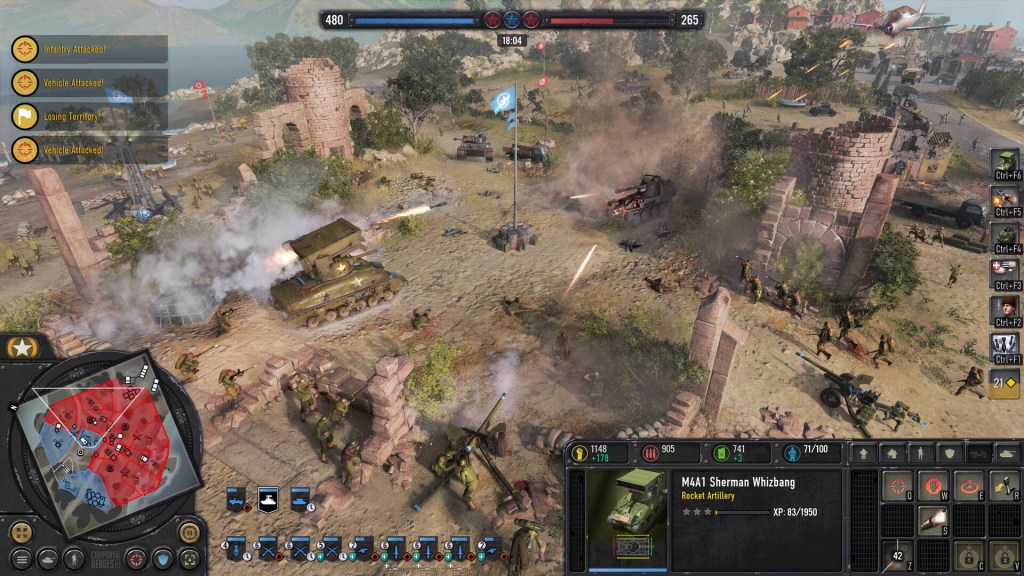
This is why positioning is so important in COH3’s combat system’s design. Even when a player has their opponent outgunned, it does not guarantee victory. Through clever tactics, maneuvering, and positioning of combatants, a player can use mechanics such as cover, garrisons, and fog of war to their advantage and defeat a stronger force. Synchronized with well timed ability usage and combined arms tactics, a player can fight back from the verge of defeat to victory. There are no silver bullets in COH3’s combat system’s design and instead was created to make it so the player must be able to predict, react, and adapt their strategy and tactics at any give moment throughout a battle.
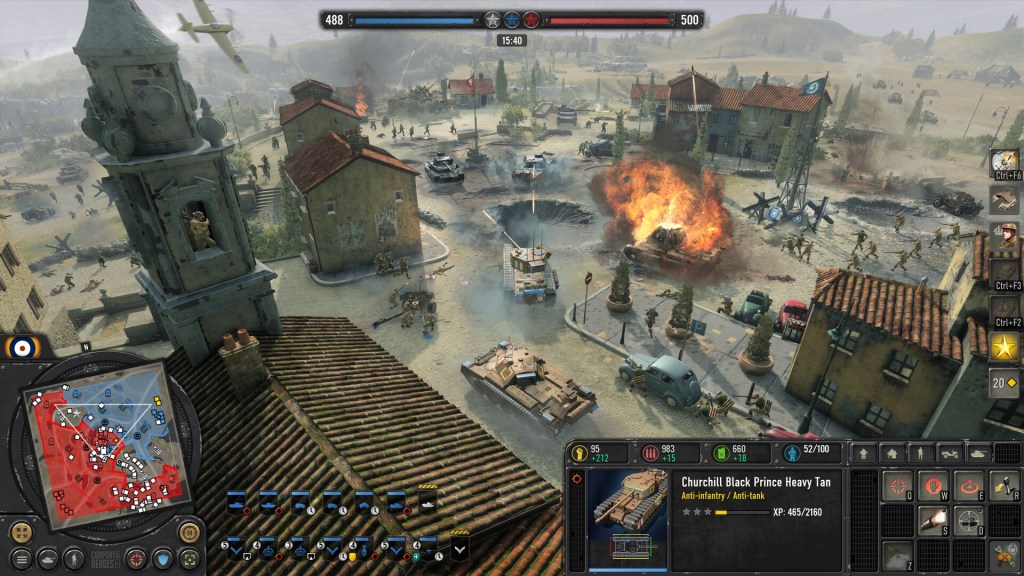
To help empower the player, the design team ensured that for every challenge, the player was given multiple choices in how to solve the problem they’re presented with that best fits their chosen tactics and strategy. Offering multiple tools to solve each problems through a diverse range of combatants, abilities, and upgrades helped achieve the design goals of creating emergent gameplay, replayability, and strategic diversity.
Factions
Company of Heroes 3 launched with four unique, asymmetric factions – The British Forces, U.S. Forces, Wehrmacht, and Deutsches Afrika Korps. As part of the gameplay team, I was responsible for designing and implementing these factions and finding creative ways to make each faction feel and play differently. Each faction was crafted to come with their own unique theme, strengths, weaknesses, combatant roster, tech tree, and identity. Below is more information regarding the process I took when designing a faction and some high level examples of the factions created for COH3.

Process
When creating factions for Company of Heroes 3, the gameplay team took a top-down approach. As a historically based WWII game, the first step in the process was to research the real-life armies the RTS factions were based on. We would identify what were the main traits and characteristics of the army based on their doctrines, tactics, military organization, arsenal, and strategies used during the war. From this we were able to derive a core theme we would want the faction to abide by and work down from there to determine each faction’s combatant roster, tech tree, and faction mechanics.
Theme
As mentioned above, the first step in the faction design process was determining the goals and unique theme for each faction. Below are the themes I helped create for each of the four factions in Company of Heroes 3:
– The U.S. Forces are highly mobile, aggressive, and adaptable, with a strong reliance on combined arms and numbers to fend off superior Axis armour
– The Deutsches Afrika Korp focus on mechanized combat, light vehicles, fast deployment, and swarm tactics to blitz and overwhelm their opponent
– The British Forces which takes on a more generalist role of defensive infantry and structures combined with fast, general purpose, armoured vehicles and tanks
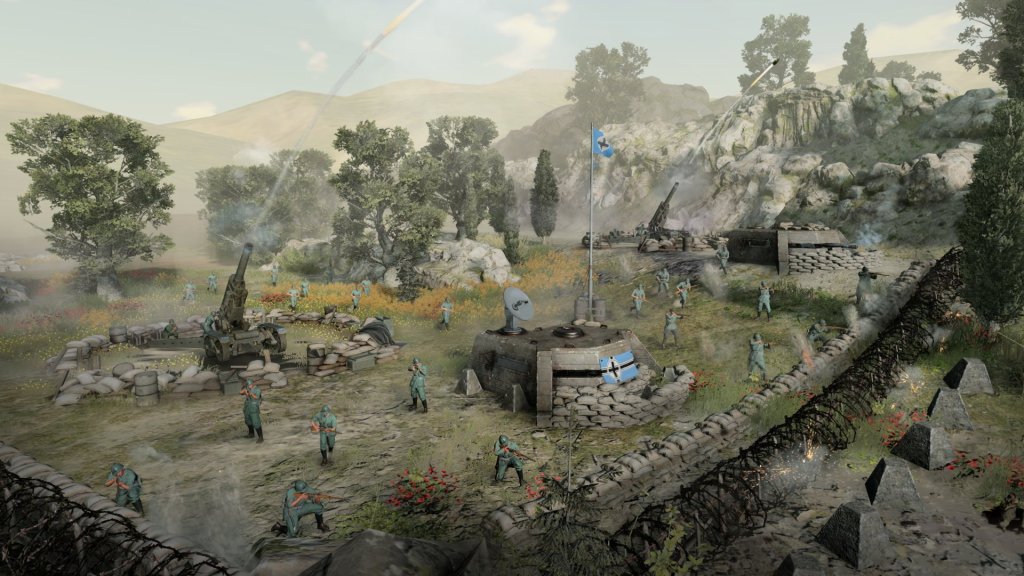
– The Wehrmacht with a heavy focus on defensive strategy and tactics that is slow to start but has the most powerful late-game combatants of any faction
Combatant Roster
After identifying the theme of a faction, the next step of the process was to determine the combatant roster. This step was largely determining the combatant count and roles the faction needed to achieve the faction’s theme and goals. As mentioned above, a lot of research went into this step to identify not only which weapons, vehicles, and infantry units (i.e. riflemen, sniper, commando, paratrooper, etc.) were used during the war, but also the tactics of how they were used. Vehicles and infantry units would then be chosen based on this research to fill the intended roles of the faction.
If the faction was meant to be more mechanized than perhaps there would be more vehicles and tanks and less infantry. If the faction was meant to be more aggressive, the light vehicles chosen would be more assault oriented, meant for hit and run tactics. If the faction was meant to be more defensive, the light vehicles might be more support oriented like medical or supply trucks and perhaps there would be less vehicles and more team weapons such as artillery and heavy machine guns to better defend territory. The combatant roster would be iterated on over time to find the right balance of combatants that met the goals for the faction.
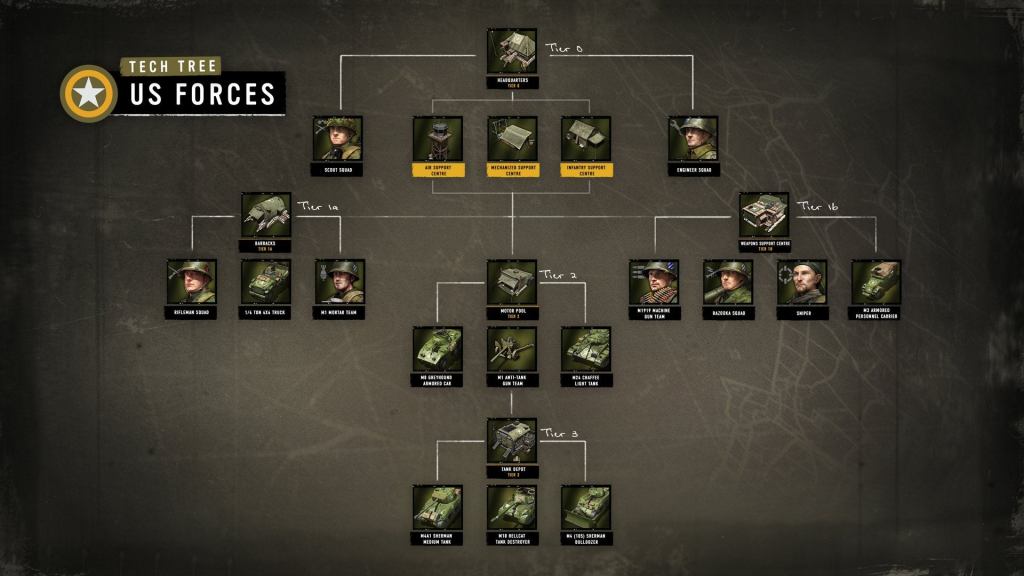
Tech Tree
As the combatant roster was determined, the faction’s tech tree would be created alongside it and both would evolve over time This is where myself and the gameplay team would determine which production building each combatant would spawn from, the cost and timings of each production building, and the intended cost and timings of each combatant. The goal during this step would be to determine the peaks and valleys of the faction; their relative power spikes and dips. This would create an eb and flow to gameplay as each faction cycled through their moments of strength and weakness, creating interesting choices for the player as they determined when, where, and how to punch, defend, and counter-punch against their opponent.

Each production building’s roster would also be created to have its own strengths and weaknesses. For example, production building A might have strong anti-infantry and production build B might have strong anti-tank. Choosing one option delays being able to build combatants from the other and thus created its own set of advantages and disadvantages that could be exploited. Each faction’s unique tech tree design promoted a variety of different build orders and strategies that enhanced emergent gameplay and replayability.
Faction Mechanics
One of the last steps of the high-level, faction design process for COH3 was determining the faction’s mechanics, upgrades, and abilities. These elements would be layered into the faction design to create additional depth and diversity within the faction and additional decision points and strategies for the player. An example of this could be a powerful weapon upgrade that is automatically applied to all existing and future combatants of a specific type, but costs the same or more as the player’s next production building.
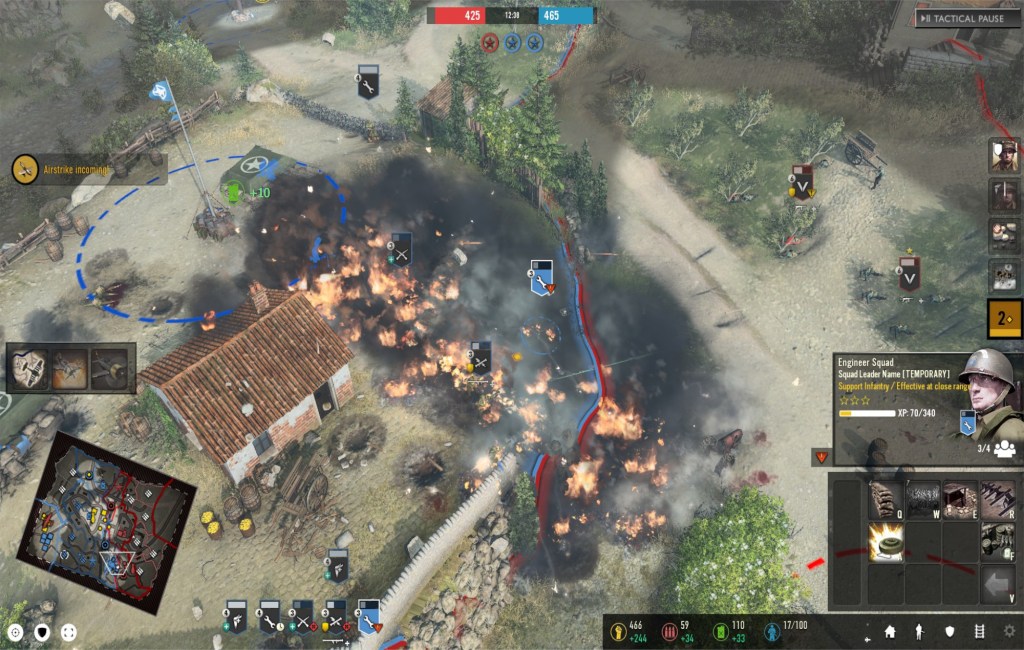
Another example could be a faction mechanic called “support centers“, which were faction upgrades that unlocked powerful player abilities such as bombing runs and airstrikes. Each faction would have their own unique mechanics that supported the faction’s theme and goals and helped set them apart from one another. These choices, or “side-techs” would be spread throughout a faction’s tech tree, creating a variety of different choices, opportunities, and costs at each stage of a match.
Combatants
As a real-time strategy game with four distinct, asymmetric factions, Company of Heroes 3 has a lot of combatants. Each faction contained a minimum of 15 unique combatants with an additional 2 – 4 “call-in” combatants available through the Battlegroup system. This presented myself and the gameplay team with significant challenges in making sure each combatant was unique with a distinct profile and role, tactical and/or strategic purpose, and was overall fun and useful for the player. To achieve this, the gameplay team took a top-down approach in combatant design, using each faction’s goals, needs, and theme to determine the direction and requirements of each combatant.
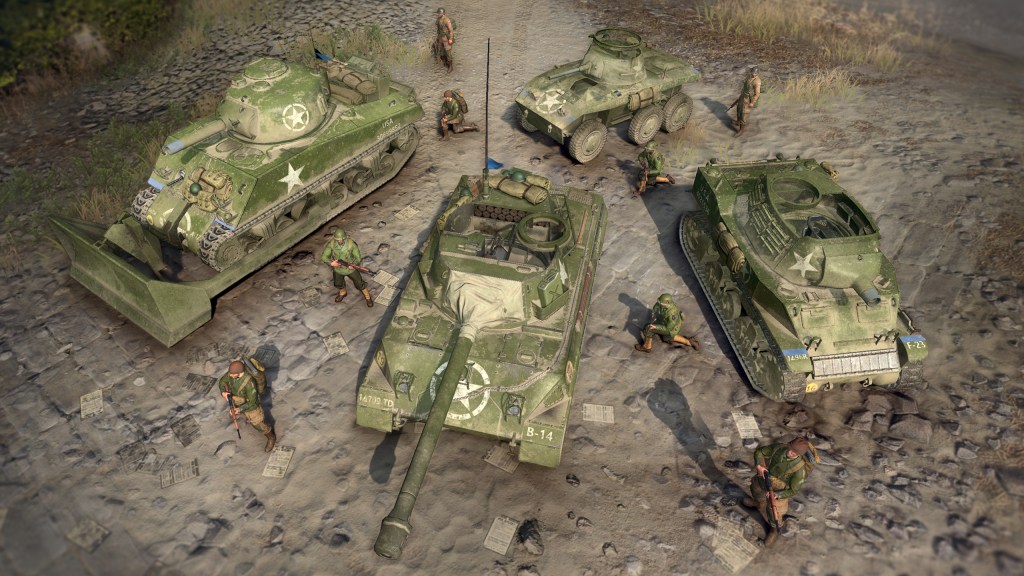
Each combatant in Company of Heroes 3 is designed to be both a tool for the player and a challenge or problem to solve in the case of enemy combatants. Each combatant is designed with distinct strengths and weaknesses that can be used to a player’s advantage but can also be exploited by their opponent. For example, heavy machine gun teams are great crowd control weapons, being able to suppress and pin large groups of enemy infantry, but are also semi-static, slow to reposition, can’t fire on the move, making them vulnerable to artillery, snipers, flanks, and vehicles. It is intended that a player must be mindful of each combatant’s strength and weaknesses so they may use, fight, and support each combatant appropriately.
Archetypes
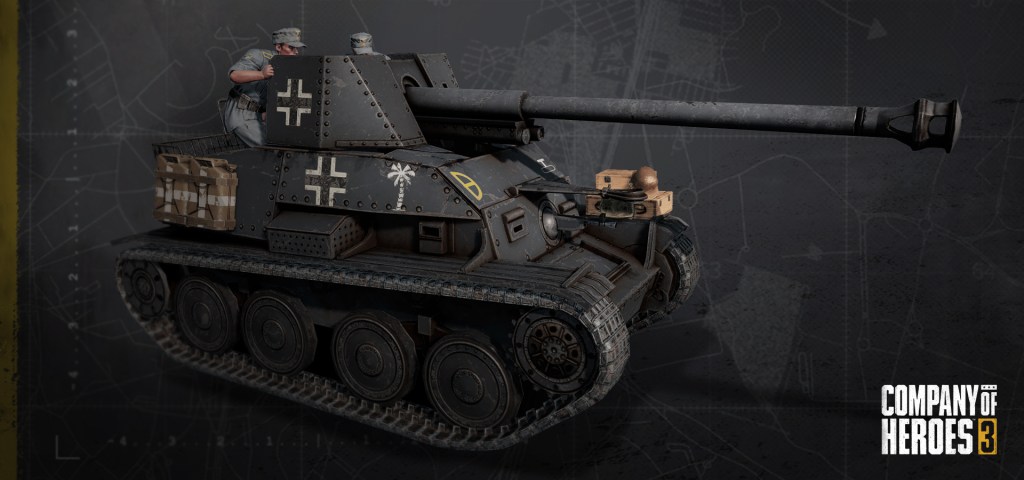
To achieve a high level of diversity in combatants, tactics, and strategy, Company of Heroes 3 uses four primary combatant archetypes: Infantry, Weapon Teams, Armoured Vehicles, and Tanks. Each archetype also contains various sub-classes such as support, assault, recon, anti-infantry, anti-tank, etc.. Combatants are further defined and differentiated by their weapons, stats, abilities, and upgrades.
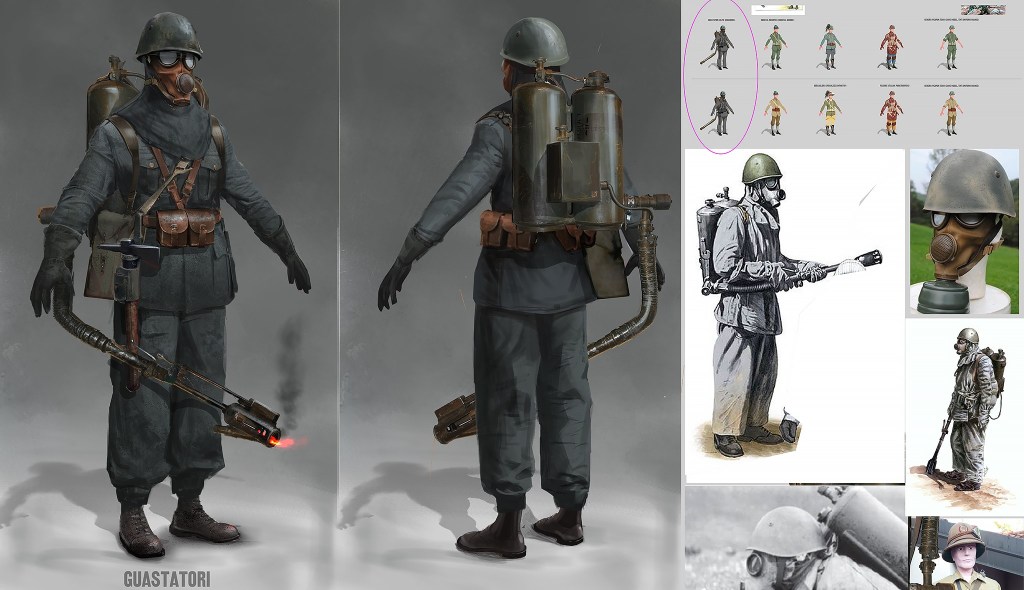
Combatants can also change their role and swap between archetypes through upgrades and weapon unlocks. For example, a support infantry combatant can be upgraded into an assault combatant with a flamethrower weapon upgrade or a combatant with a long-range rifle can change their role into a close-quarters combatant with a weapon upgrade to a sub-machine gun that replaces their rifle. Below are some examples of high-level, combatant profiles I designed and created for Company of Heroes 3.
Infantry
Riflemen
– Faction: U.S. Forces
– Default Role: Generalist assault infantry, effective at close and mid-range combat
– Vulnerability: Ineffective vs long-range combatants and vulnerable to vehicles
– Default Abilities: Standard grenade, anti-tank grenade, garrison breach, capture speed bonus (passive)
– Default Upgrades: Light-machinegun
– Description: Durable, mobile, and armed with mid-range rifles and grenades, the Riflemen are an effective assault squad capable of dislodging enemy positions and capturing territory. Through weapon upgrades, veterancy bonuses, and ability unlocks, the Riflemen squad are a well rounded unit for all stages of a match.
Weapon Teams
Bofors Anti-Air Emplacement
– Faction: British Forces
– Default Role: Anti-air and anti-infantry
– Vulnerability: Static, vulnerable to artillery and indirect fire
– Default Abilities: Armour Piercing Rounds, Brace
– Default Upgrades: None
– Description: The 20mm Bofors anti-air gun is a static but deadly weapon that can be either towed on to the battlefield or constructed in place. Capable of firing rapid fire rounds, the 20mm gun is an extremely effective weapon at holding territory against lightly armoured vehicles, infantry, and enemy aircraft.

Armoured Vehicles
Sd.Kfz 251 Halftrack
– Faction: Wehrmacht
– Default Role: Support vehicle
– Vulnerability: Lightly armored and armed, doesn’t serve as a direct combat role
– Default Abilities: Infantry transport, mobile reinforcement
– Default Upgrades: Medical Supplies or 75mm Low-Velocity Gun (disables transport and reinforce abilities)
– Description: Lightly armoured and mobile, the 251 Halftrack allows players to transport and reinforce squads on the battlefield. Equipped with two unique upgrades, the 251 Halftrack can either provide frontline healing with medical supplies or provide combat support with a short-range, 75mm low-velocity gun that fires high-explosives rounds and is effective at neutralizing enemy infantry.
Tanks
Tiger Tank
– Faction: Deutches Afrika Korp
– Default Role: Heavy assault tank
– Vulnerability: Slow moving, easy to flank and swarm
– Default Abilities: Blitzkrieg, self-repair
– Default Upgrades: HMG-42 Top Gunner
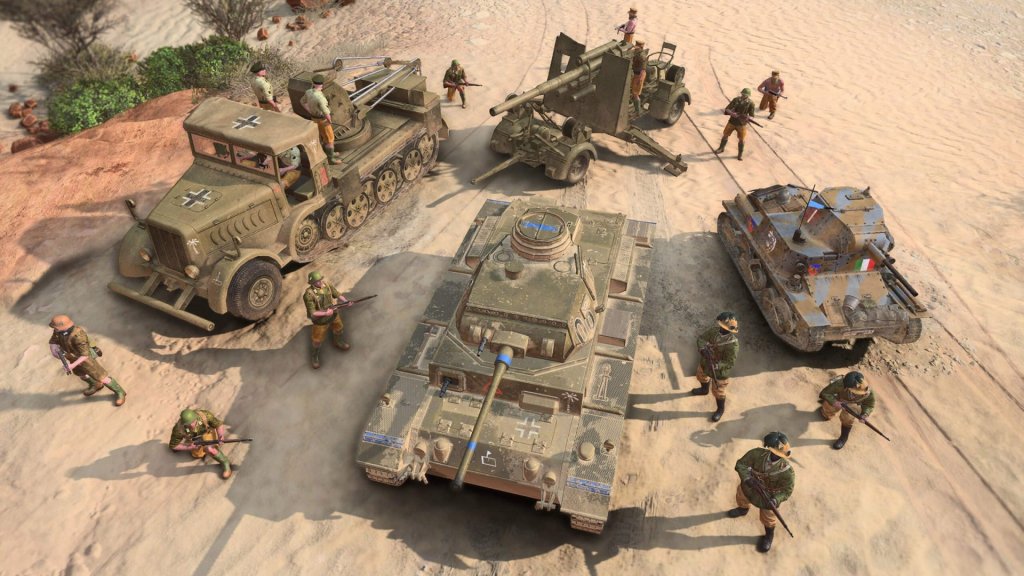
– Description: The Tiger tank is an extremely heavy armoured vehicle capable of spearheading through defences and soaking up enemy fire from all sources. Equipped with a massive, 88mm main gun, the Tiger tank can quickly destroy anything the allied forces can throw at it, including infantry, static emplacements, and opposing tanks of all calibers.
Systems
Throughout Company of Heroes 3’s development I worked on nearly every one of its gameplay and combat systems as either an owner or a contributor. From core systems such as damage, health, projectiles, movement, weapons, upgrades, and abilities, to more specialized systems such as towing, vehicle recovery, repair, and height gameplay. These systems were the framework that tied all of the RTS gameplay together. Below are some of the more player-facing, gameplay-centric systems that I worked on from conception to ship and their intended impact on gameplay.
Battlegroups
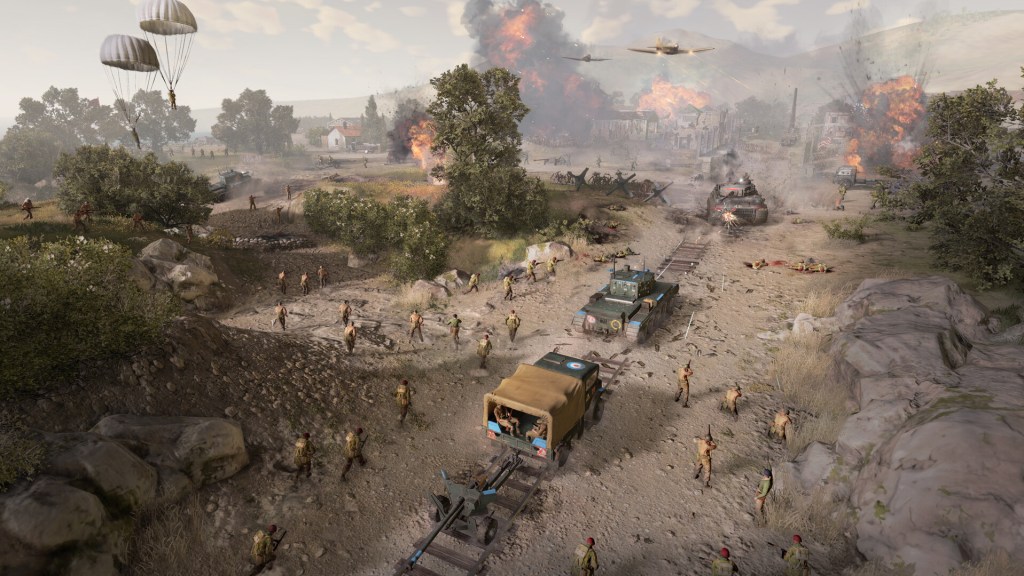
The Battlegroup system for Company of Heroes 3 was designed to allow players to augment their faction in different and interesting ways each time they played. Since creating all new factions was an expensive and time consuming process, Battlegroups allowed the gameplay team to create additional depth and diversity, where each faction’s Battlegroup acted as a sub-faction or sub-class of the faction.
Building off the “Doctrine” and “Commander” systems of Company of Heroes 1 and 2, the Battlegroup system of COH3 layers in additional and exclusive choices the player can make. During a match, each player picks one of three Battlegroups to augment their faction. Each Battlegroup is designed with a unique theme, such as Special Forces or Airborne, and consists of unique abilities and combatants that fit its theme.
For example, an Airborne Battlegroup would allow the player to use powerful air strike abilities, air drop in additional resources or weapons, and quickly air drop paratrooper infantry to any point of the map. Gameplay and combat was designed to heavily revolve around a player’s Battlegroup choice, with build orders and moment-to-moment choices supporting and supplementing a selected Battlegroup.
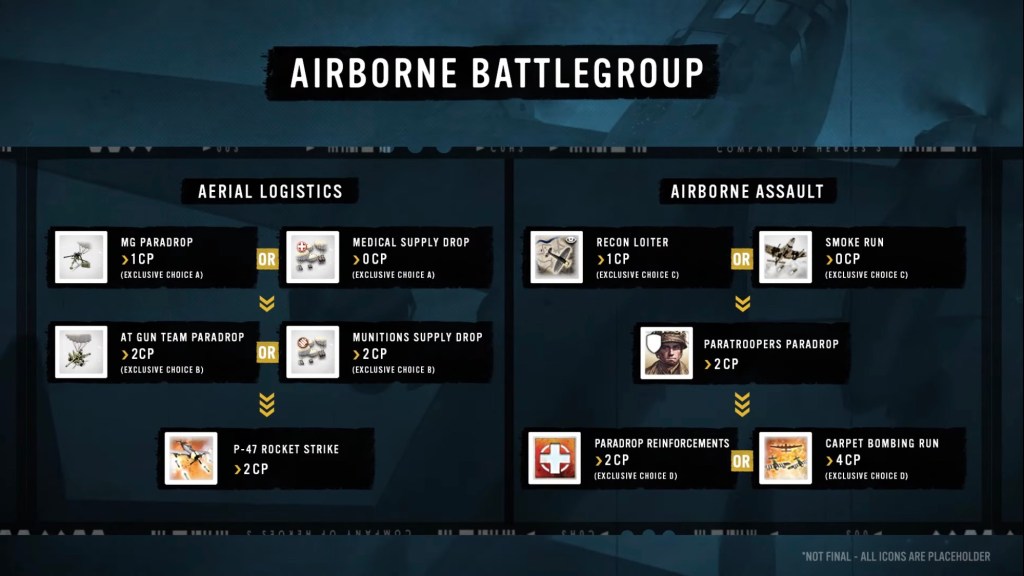
The Battlegroup system design resembles that of a skill tree, with linear, progressive unlocks and exclusive choices. The player earns “Skill Points” throughout a match and can then spend these Skill Points on unlocking new Battlegroup abilities and combatants. Each unlock would have its own unique Skill Point cost and sometimes would also be an exclusive choices between another unlock.
Each Battlegroup consists of two branches, each branch with its own sub-theme, i.e. branch one might be air strike focused and branch two might be more air drop / combatant focused. The unlocked abilities and combatants in each branch become progressively more powerful, making going down one branch an opportunity cost to the unlocks in the second branch. The abilities and combatants at the end of each branch were typically some of the most powerful abilities and combatants in the game, making a player’s Battlegroup selection and choices all the more critical to their strategy and tactics.
Penetration & Armour
The Armour and Penetration system was intended to add an extra layer of immersion and “realism” to the game while also acting as tuning attributes for creating different levels of power for combatants such as tanks and vehicles. This was also one of the RNG systems of Company of Heroes that created emergent gameplay and memorable moments throughout a match.
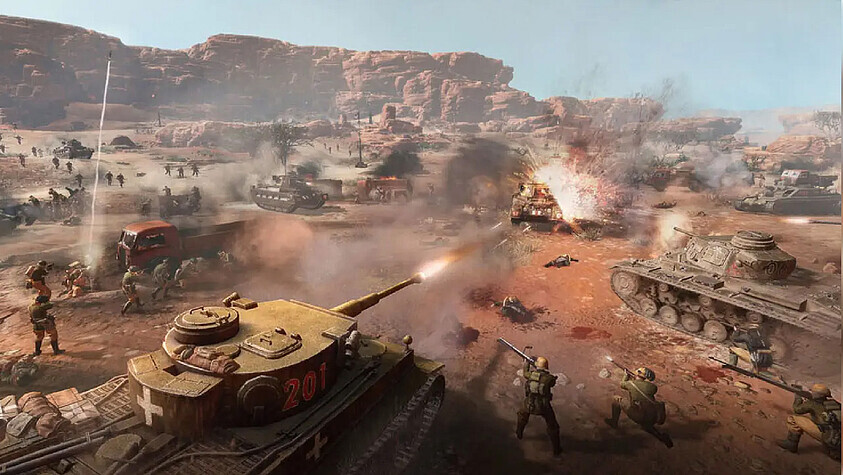
Each armoured combatant in Company of Heroes 3 has three main armour attributes, front, side, and rear armour. Frontal armour is always the strongest, then side, and then rear armour is the combatant’s weak or vulnerable point. Each weapon in Company of Heroes 3 has a penetration value. When a weapon fires on an armoured combatant, the weapon’s penetration value is calculated against the target’s armour value and the system randomly determines if the fired shots will penetrate and deal damage to the target or not.
For example, if a weapon has a penetration value of 50 and the armoured combatant has an armour value of 100, then each shot the weapon fires that hits the target has a 50% chance to penetrate and deal damage. In the case of small arms, such as rifles and machineguns, these weapons can’t penetrate armoured combatants due to their low penetration values, making combatants that use these weapons vulnerable to vehicle assaults, forcing the player to rely on combined arms and use diverse tactics.

This penetration / armour dynamic allowed the gameplay design team to create nuanced vehicle combat. Players are encouraged to flank their opponent’s armoured combatants to fire at their weaker side and rear armour, but in doing so also potentially over extend their forces, making them open to getting flanked themselves, kited, or fall intro traps. This system also helped create a diverse range of weapon and armour profiles, abilities and upgrades such as “armour piercing rounds” or “target weak point” that added depth to combatants and exciting moments, allowing weaker combatants turn the tide in a fight against a stronger, more heavily armoured enemy. Lastly, the RNG element of the armour and penetration system created memorable moments of bounced shots (non-penetrating hits), narrow escapes, and well timed and orchestrated vehicle assaults.
Veterancy
The veterancy system in Company of Heroes 3 is a system that promotes squad (combatant) preservation by unlocking new powerful passive and active abilities through gained experience over time. Unlike many RTS games where units are largely considered expendable, success in Company of Heroes 3 is determined by a player’s ability to keep their combatants alive through strong combat awareness and smart tactical choices.
The Veterancy system at its roots is essentially an XP system that is applied to every combatant in the game. Combatants earn XP through combat and actions and when enough XP is earned they “level up” to a maximum of three levels. Each new level a combatant reaches provides them with strong passive bonuses such as increased damage or accuracy and potentially unlocks a new active ability.
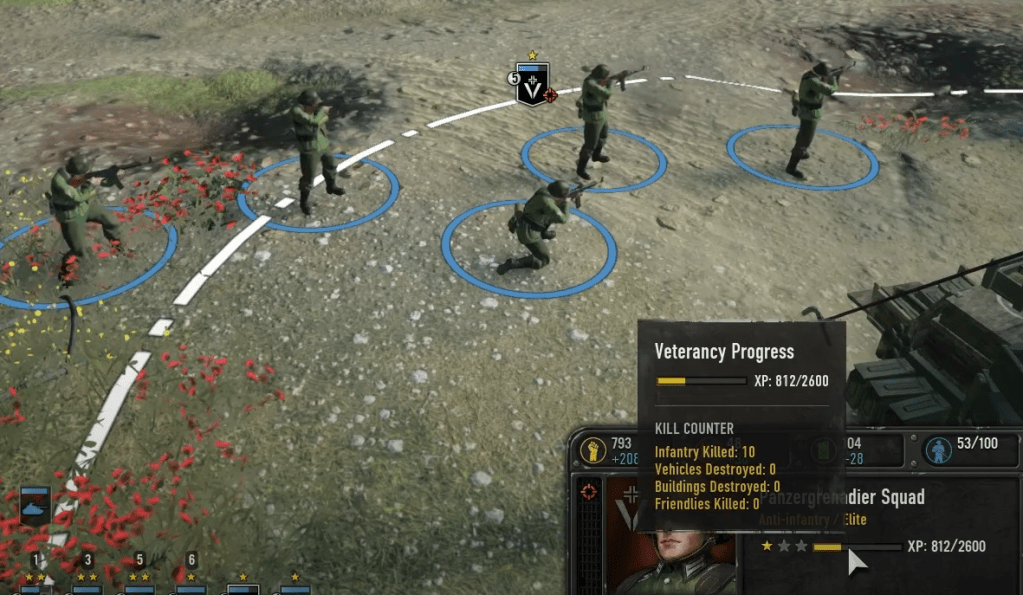
By keeping combatants alive and leveling them up, the player receives a massive combat advantage and increased power curve throughout a match. This also creates exciting moments and mini-games of hunting an opponent’s high-value targets. By killing a fully leveled combatant, the player can capitalize on this advantage and opportunity.
Breach
Garrisoning squads in buildings provides strong defensive benefits. Player feedback from the previous games in the franchise was that garrisoned buildings could cause balance issues early in a match before many counters came online, allowing the first player to reach a building to lock down large sections of a map. To address this feedback, one of the counters to garrisoned buildings introduced in Company of Heroes 3 was the Breach system. A unique ability that allowed certain combatants to assault an enemy garrisoned building and evacuate the opposing squads, dealing significant damage.
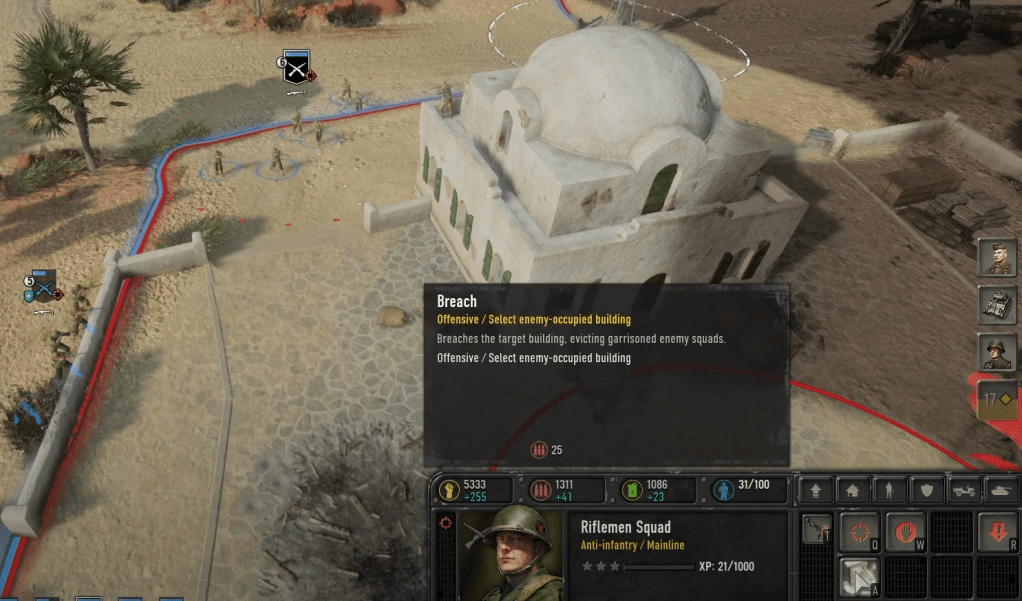
The breach system posed multiple challenges for the design team. What was the minimum entity count of a squad to be able to breach a building? What if the building was garrisoned by two enemy squads or they had a much higher entity count than the breaching squad? Could all squads breach or just certain squads, what other requirements should the breaching squad have, such as grenades or submachine guns? Should all buildings be “breachable”, what about small buildings with only one door?
It took multiple iterations and nuances to get this system to feel natural, intuitive, and balanced. In the end, it added exciting depth and diversity to player’s strategies and tactics and became a fan favourite ability, especially amongst new players where countering garrisoned buildings was typically the most challenging.
 Kyle Fehr Design